Introduction of “Japanese cue sign” and “Japanese mouth symbol”
Japanese Cue Sign Association(JCSA)
The Japanese Cue Sign Association conducts discussions on the significance and usage of “cue signs,” which have been used in schools for the deaf and are effective in helping deaf children acquire Japanese. The Japanese Cue Sign Association was launched in 2016.
In the field of education for the hearing impaired, many cases have been reported in which visual representations of Japanese phonemes (mainly consonants) have been effective for children whose hearing is inadequate, even for those using hearing aids from an early age.
This site introduces a “Japanese cue sign” (trial version) that is easy to use for infants and toddlers with immature finger coordination skills, and also for their parents to master. We expect to find various improvements in this “Japanese cue sign” through actual trial use, and we will continue to modify it in the future without changing the basic policy.
Tsuneo Harashima (University of Tsukuba)
Hiroto Chonan (Tsukuba University of Technology)
Kiyoko Wakinaka (Tsukuba University of Technology)
What is Japanese cue sign?
In Japan, “signs for pronunciation instruction” were used in many schools for deaf students before World War II; however, their use was limited to pronunciation instructions.
After World War II, the Kyoto Prefectural School for the Deaf began using “signs for pronunciation instruction” in Japanese language instruction, and the results were so successful that it spread nationwide. The signs, which are used in Japanese language instruction and daily communication, are now called “cue signs” to distinguish them from the “signs for pronunciation instruction,” that were used only in pronunciation instruction. Since each school began using cue signs for their own internal use, they vary from school to school.
Some people refer to the “cue sign” used in Japan as “cued speech,” but the “cued speech” developed by Cornette in the United States and the “cue signs” used in Japan are different. Since the establishment process and the hand patterns are different, we use the term “cue sign” in order to clearly distinguish between them.
Advantages of Cue Signs
- Japanese cue sign can easily match the speed and rhythm of actual speech and convey Japanese phonology accurately and in real-time. Since one beat (mora) in Japanese consists of simple consonants and vowels, which are produced in a certain rhythm, the simple cue sign unique to Japanese is very easy to learn and use.
- The use of cue signs, in addition to lip-reading, complements the consonantal information that is lacking in the combination of auditory information and lip-reading and helps to ensure that phonemes are conveyed more accurately. In addition, the habit of lip-reading or speechreading is likely to continue even when cue signs are no longer used.
- Cue signs are easier to learn than Japanese fingerspellings because they have fewer handshapes (there are 11 handshapes for cue signs compared to 45 Japanese fingerspellings).
- Cue signs are easy to use, even for children who have not yet mastered finger manipulation (in the Japanese Cue Sign, the basic shape is “five fingers spread” for clear sound and “index finger held up” for voiced sounds, so even one-year-old children can make the shape).
Purpose of devising a “Japanese cue sign” and publishing it on the Web
- The “Japanese cue sign” does not prevent children from using sign language and Japanese fingerspelling, nor does it encourage schools for the deaf, which currently use their own cue signs, to change to Japanese cue signs. We hope that this will serve as a model for schools that will introduce cue signs in the future, schools that are revising their cue signs, and parents who are considering using cue signs for more reliable communication at home.
- Why did we develop a “Japanese cue sign”? The purpose is to reduce situations in which children are unable to express themselves because the traditional cue signs vary from school to school and from person to person.
- Purpose of publishing on the Web
- To inform those involved in the education and care for the hearing impaired.
- To inform parents of deaf children(when Japanese cannot be conveyed accurately even with cochlear implants, a means of visually complementing Japanese phonology is necessary. For parents and children who feel that it is difficult to learn Japanese fingerspellings, we introduce Japanese cue signs that are easy for even infants to learn.)
- In France, the birthplace of deaf education, the effectiveness of cued speech has been confirmed, and cued speech interpreters have also been trained. It can thus be expected that cue signs will be an effective interpretation method in Japan in the future.
Basic Policy for Designing the “Japanese Cue Signs”
- Utilize the features of pronunciation (e.g., tongue movement with hands) as the expression
- Ensure they are usable even by infants
- Ensure that the mouth shape is not hidden for lip-reading or speechreading
- A cue sign with a dakuten is associated with a cue sign without a dakuten.
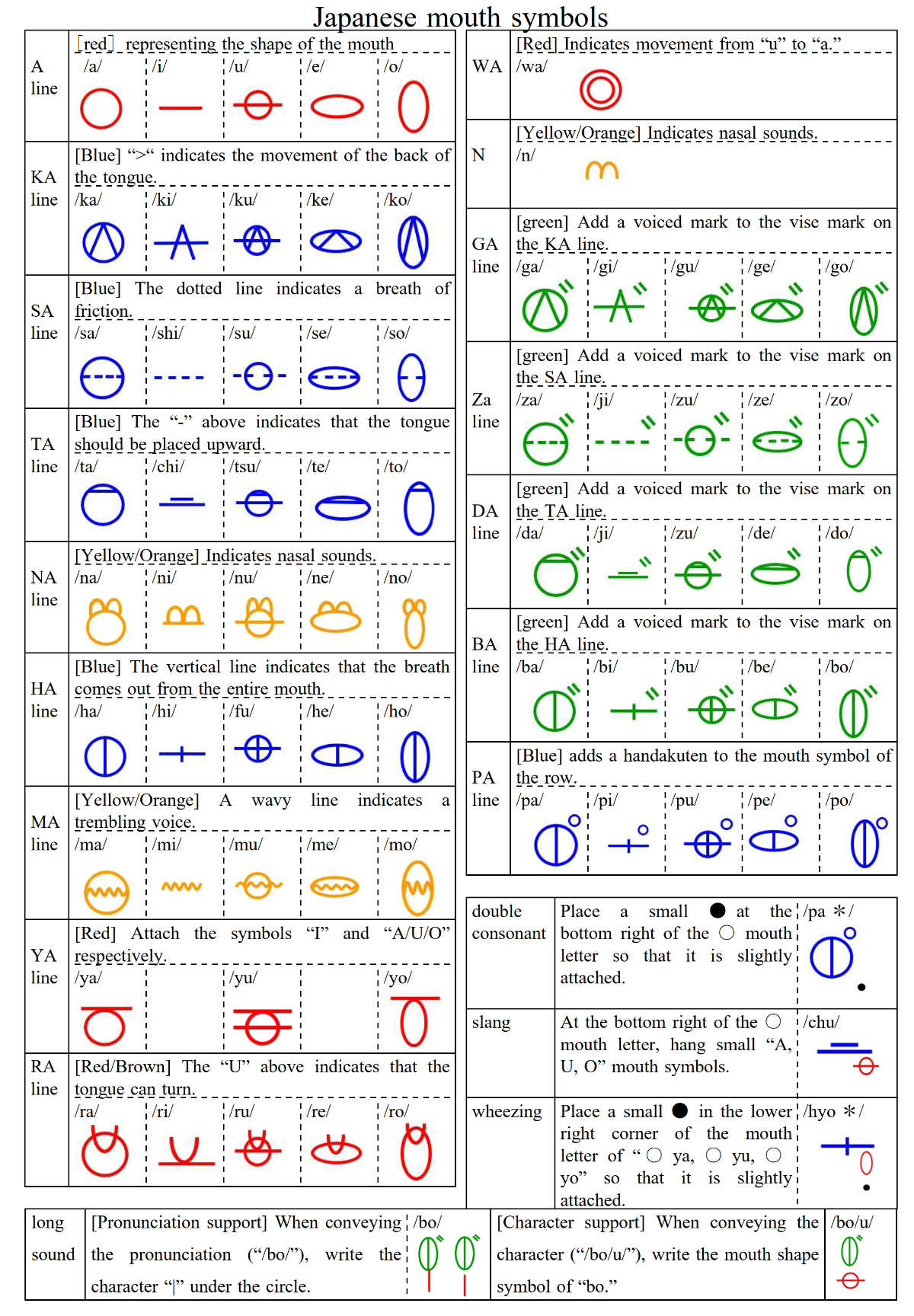
Purpose of devising “Japanese mouth symbols” and publishing it on the Web
Since before World War II, “mouth symbols” or “mouth letters” have been used in schools for the deaf to teach pronunciation, and as symbols for the preliminary stages of hiragana.
- We do not intend to encourage schools for the deaf that currently use their own mouth symbols or letters to change to Japanese mouth symbols. These symbols are intended to serve as a model for schools that are planning to introduce or review their use of mouth symbols, and for parents who are considering the use of mouth symbols for more reliable communication within the home or as a pathway to hiragana.
- Reasons for devising “Japanese mouth symbols”
The traditional mouth symbols, that are used differently by different schools and people, do not cause barriers in communication because of their short period of use. However, deaf schools that no longer use the mouth symbols will be able to use them again.
Purpose of publishing on the Web
- To inform those involved in education and care of the hearing impaired.
- To inform parents of deaf children (When Japanese cannot be conveyed accurately, even with cochlear implants, a method of visually representing Japanese phonology is necessary. Here, we introduce Japanese mouth symbols that are easy to learn even for infants who have not yet learned hiragana).
Those shown in / / are in Japanese phonemes. Those shown in [ ] are in International Phonetic Alphabet.
Basic policy for devising “Japanese mouth symbols”
- Utilizing the characteristics of symbols to connect pronunciation and hiragana when teaching pronunciation.
- The symbols should be simple and easy to write.
- Vowels are red, nasal sounds are yellow or orange, unvoiced plosives and fricatives are blue, and voiced plosives are green.
- Since it is difficult to use a variety of colors when expressing words with mouth symbols, it should be possible to distinguish them even if they are all black.
- If /a/([a]) is represented by a large circle and /u/([ɯ]) by a small circle, it is difficult to distinguish them with only one symbol thus, they can be discriminated regardless of their size.
- A mouth symbol with dakuten is related to a mouth symbol without dakuten.
- Consider the relationship with the beat (mora).
Supplementary explanation
- Since there are cases in pronunciation instructions where /ya/ ([ja]) is taught as /i/+/a/ ([j]+[a]), /yu/ ([jɯ]) as /i/+/u/ ([j]+[ɯ]), and /yo/ ([jo]) as /i/+/o/ ([j]+[o]), the mouth symbol for the /ya/ ([ja]) line was created by placing the /i/ ([j]) symbol on top of the /a/ ([a]), /u/ ([ɯ]) and /o/ ([o]) symbols for the vowels.
- For the contracted sound /kya/ ([kʲa]) , /kyu/ ([kʲɯ]), /kyo/ ([kʲo]), we thought that /kya/ ([kʲa]) was close to /ki/+/a/([kʲi]+[a]) and decided to place a small /a/ ([a]) symbol at the lower right corner of the /ki/ ([kʲi]) symbol. Similarly, /shu/ ([ʃɯ]) was considered to be similar to /shi/+/u/ ([ʃi]+[ɯ]) and a small /u/ ([ɯ]) symbol was placed at the lower right corner of the /shi/ ([ʃi]) symbol.
- Regarding the beat (mora), /kya/ ([kʲa]) and /shu/ ([ʃɯ]) are counted as one beat (mora) respectively, and the geminated consonant /*/ (/Q/) is counted as one beat (mora) by itself.
Recorded contents
List of videos and illustrations of Japanese cue signs